


The Truth About Collagen: What Actually Stimulates It and What Simply Sits on the Surface

Collagen has become one of the most overused words in the beauty industry. It appears on creams, powders, serums, supplements, and social media promises, often presented as if it were something we can simply “rub back into” the skin. But collagen physiology is far more nuanced, intelligent, and fascinating than marketing tends to suggest.
At Shoreline Glow, I believe understanding the why behind skin changes matters just as much as the treatments themselves. Not because aging is something to fear, but because our skin deserves informed support as it evolves through time, hormones, stress, sunlight, environment, and life itself.
Healthy skin is not about chasing youth. It is about preserving function, resilience, integrity, and vitality for as long as possible.
So let’s talk about collagen properly.
What Is Collagen?
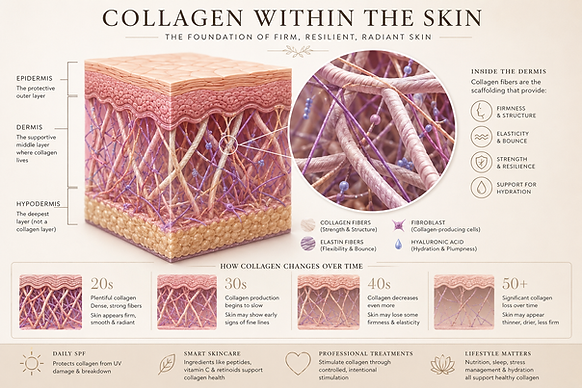
Collagen is the most abundant structural protein in the human body. It acts like the scaffolding of the skin, helping maintain firmness, elasticity, strength, and overall architecture.
In the skin specifically, collagen lives primarily within the dermis, the deeper layer beneath the epidermis. Fibroblast cells are responsible for producing collagen, elastin, and other structural components that keep skin strong and resilient.
There are multiple types of collagen in the body, but Types I and III are the most abundant in youthful skin.
Think of collagen as part of your skin’s support network:
Elastin allows skin to stretch and bounce back
Hyaluronic acid helps maintain hydration
Collagen provides structure and tensile strength
Over time, that support network naturally changes.
When Do We Begin Losing Collagen?
Research suggests collagen production begins slowing in our mid-to-late 20s, with an average decline of approximately 1% per year thereafter.
For women, menopause creates one of the most significant shifts in collagen physiology:
Up to 30% of collagen can be lost within the first 5 years after menopause due to declining estrogen levels
After that, collagen loss continues at approximately 2% annually for many women
This is one reason menopausal skin may suddenly feel thinner, drier, less elastic, or slower to recover.
But aging alone is not the only factor affecting collagen.
What Accelerates Collagen Breakdown?
Several internal and external factors influence collagen degradation:
UV Exposure
Sun exposure is one of the largest contributors to premature collagen breakdown, a process known as photoaging.
Ultraviolet radiation generates free radicals that damage collagen fibers and stimulate enzymes called matrix metalloproteinases (MMPs), which actively break collagen down.
This is why daily SPF is one of the most important collagen-preserving habits available to us.
Not because we are afraid of aging. But because protecting the skin’s integrity matters.
Smoking
Smoking significantly impairs circulation and collagen synthesis while increasing oxidative stress.
Chronic Stress
Elevated cortisol over time may impair barrier repair and contribute to collagen degradation through inflammatory pathways.
Poor Sleep
Skin repair processes occur heavily during sleep cycles.
High Sugar Intake
Excess sugar contributes to glycation, where sugar molecules attach to collagen and elastin fibers, making them stiffer and less functional over time.
Hormonal Changes
Especially declining estrogen during perimenopause and menopause.
Can Topical Collagen Creams Replace Lost Collagen?
This is where marketing often becomes misleading.
Collagen molecules are generally too large to penetrate deeply enough into the dermis where collagen production actually occurs. Most topical collagen products primarily function as moisturizers or film-forming hydrators on the surface of the skin.
That does not mean these products are useless. They may temporarily improve hydration and make the skin appear smoother or plumper.
But they are not rebuilding collagen structures deep within the skin.
In other words: Applying collagen onto the skin is not the same thing as stimulating your skin to produce new collagen itself.
Those are two very different physiological processes.
What Actually Stimulates Collagen?
True collagen stimulation occurs when fibroblast cells receive signals that encourage repair, renewal, and remodeling.
This can happen through:
Biochemical signaling
Controlled chemical stimulation
Physical stimulation
Thermal stimulation
At Shoreline Glow, the collagen-supportive treatments I offer remain within my professional scope of practice and focus on supporting the skin’s natural regenerative intelligence rather than forcing excessive inflammation.
There are more advanced medical procedures available today, including deeper ablative lasers, injectable biostimulators, and surgical interventions. Personally, I would only pursue those modalities under the care of a licensed dermatologist or physician with advanced medical training.
Because true skin health should always be approached with both curiosity and respect.
Biochemical Support: Enzymes & Intelligent Skin Communication
Not all collagen-supportive treatments rely on aggressive stimulation.
Some of the most elegant approaches work with the skin’s biology rather than forcing excessive inflammation. This is where enzyme therapy and advanced peptide technology become incredibly valuable.
At Shoreline Glow, one of the professional systems I work with extensively is the O Cosmedics professional skincare range, particularly their enzyme resurfacing systems and V8 Peptide Complex technology.
Unlike traditional exfoliation that may rely heavily on acids alone, enzymes work by selectively digesting keratin protein buildup and redundant surface cells without creating the same level of irritation or barrier disruption associated with more aggressive approaches.
This matters because chronic inflammation and over-exfoliation can eventually impair skin function rather than strengthen it.
Healthy collagen stimulation is not about attacking the skin into submission. It is about creating the right environment for communication, repair, and renewal.
How Enzymes Support Skin Renewal
Enzyme exfoliation helps:
Encourage healthy cellular turnover
Improve surface texture and luminosity
Reduce buildup that can impair ingredient penetration
Support smoother skin function
Prepare the skin for deeper professional treatments
When the surface of the skin is functioning optimally, fibroblast signaling and treatment outcomes may become more efficient overall. Enzymes essentially help remove the “noise” at the surface so the skin can function more intelligently.
The Role of Peptides in Collagen Communication
One of the reasons peptide technology has become so respected in modern corneotherapeutic skincare is because certain peptides act as biological messengers.
Rather than forcing trauma, they communicate with fibroblast cells through signaling pathways.
The V8 Peptide Complex found within several O Cosmedics formulations combines multiple peptide technologies designed to support:
Collagen synthesis signaling
Skin repair pathways
Barrier resilience
Elasticity support
Overall skin vitality
Certain peptides, such as palmitoyl pentapeptide, function as signal peptides. These small amino acid chains can mimic fragments of broken collagen, essentially signaling to fibroblasts that repair activity is needed.
In simple terms: they help “remind” the skin to behave more optimally. This is one of the major differences between advanced peptide formulations and traditional collagen creams. Collagen creams themselves generally sit on the surface due to their large molecular size, offering hydration benefits but limited true dermal stimulation.
Peptides, however, are significantly smaller and can participate in cellular communication processes that support long-term skin function. This is why modern professional skincare has shifted away from simply coating the skin and toward supporting the skin’s own regenerative intelligence.
Chemical Stimulation: Chemical Peels
Professional chemical peels work by creating controlled exfoliation and injury signaling within the skin.
Depending on the depth and formulation, peels can:
Accelerate cellular turnover
Improve pigment irregularities
Stimulate fibroblast activity
Support smoother texture
Encourage collagen remodeling over time
Ingredients such as:
Lactic acid
Glycolic acid
Salicylic acid
TCA (within appropriate professional scope)
can all contribute to different levels of stimulation and renewal.
The key is controlled, intentional application.
Not aggressive damage. Not “burning the skin off. ”Not chasing extreme peeling.
Healthy collagen stimulation should respect barrier integrity and healing capacity.
Physical Stimulation: Microneedling
Microneedling is one of the most researched collagen induction therapies available within esthetic practice.
Through controlled micro-injuries created by fine needles, the skin initiates a wound-healing cascade that stimulates fibroblast activity and collagen production.
The body responds in phases:
Inflammation phase
Proliferation phase
Remodeling phase
During this process, new collagen and elastin fibers are gradually formed over weeks to months.
Microneedling may help improve:
Fine lines
Acne scarring
Skin texture
Enlarged pores
Overall skin resilience
But collagen remodeling is not instant. This is one reason consistency and patience matter more than dramatic promises.
Thermal Stimulation: Radio Frequency
Radio Frequency (RF) treatments use controlled heat energy delivered into deeper layers of tissue.
This thermal stimulation can:
Trigger collagen remodeling
Encourage tissue tightening
Support fibroblast activity
Improve skin firmness gradually over time
Heat creates a controlled stress response that encourages the skin to repair and strengthen itself. Again, the goal is not punishment. It is communication with the skin’s natural repair systems.
The Role of Vitamin A and Vitamin C
No collagen conversation is complete without these two powerhouse ingredients.
Vitamin A (Retinoids)
Vitamin A derivatives help:
Normalize cell turnover
Stimulate collagen production
Improve skin texture
Reduce collagen breakdown over time
Retinoids remain among the most studied topical ingredients in dermatology.
Vitamin C
Vitamin C is essential for collagen synthesis itself.
Without adequate Vitamin C, collagen formation becomes impaired.
It also functions as a powerful antioxidant, helping protect collagen from free radical damage caused by UV exposure and environmental stressors.
Why SPF Matters More Than Most “Anti-Aging” Products
If collagen preservation is the goal, sunscreen is not optional.
Daily SPF helps:
Reduce collagen degradation
Protect against UV-induced free radicals
Prevent accelerated photoaging
Preserve treatment results
Reduce inflammation and pigment dysregulation
Many people spend hundreds on collagen products while skipping consistent SPF use.
That is like renovating a house while leaving the windows open during a storm.
The Truth Most Marketing Leaves Out
Collagen stimulation is rarely about one miracle product.... It is cumulative.
It is:
Consistent SPF use
Professional treatments performed appropriately
Barrier support
Nutrient support
Sleep
Stress regulation
Hormonal awareness
Patience
Repetition over time
And perhaps most importantly: understanding that skin is alive. It is constantly adapting, communicating, protecting, repairing, and responding to the environment we place it in.
At Shoreline Glow, my approach is never about “fighting age.” I believe our skin tells the story of a life being lived. My role is simply to help support its function, resilience, vitality, and integrity as that story continues unfolding.
Because sometimes the most powerful thing we can do for our skin is stop trying to wage war against it, and instead learn how to support it wisely through every season of life.
I hope this article helped provide meaningful education and a deeper understanding of how to best support your skin through every stage of your life. Our skin is not something to battle against, but something we are entrusted to care for with wisdom, consistency, and compassion.
The goal is not perfection or the pursuit of eternal youth, but helping the skin remain healthy, resilient, and radiant in a way that reflects the beautiful human being living within it. When we learn to become better stewards of our skin rather than critics of it, our relationship with aging, beauty, and self-care begins to transform in a much more meaningful way.
With love,
Paty C.


Comments